
Choose how each answer is made.
Every conversation runs on one of three answer tiers, named for the classical orders from the plainest to the most elaborate. Pick the tier the question deserves, and how long it reasons.
Three tiers
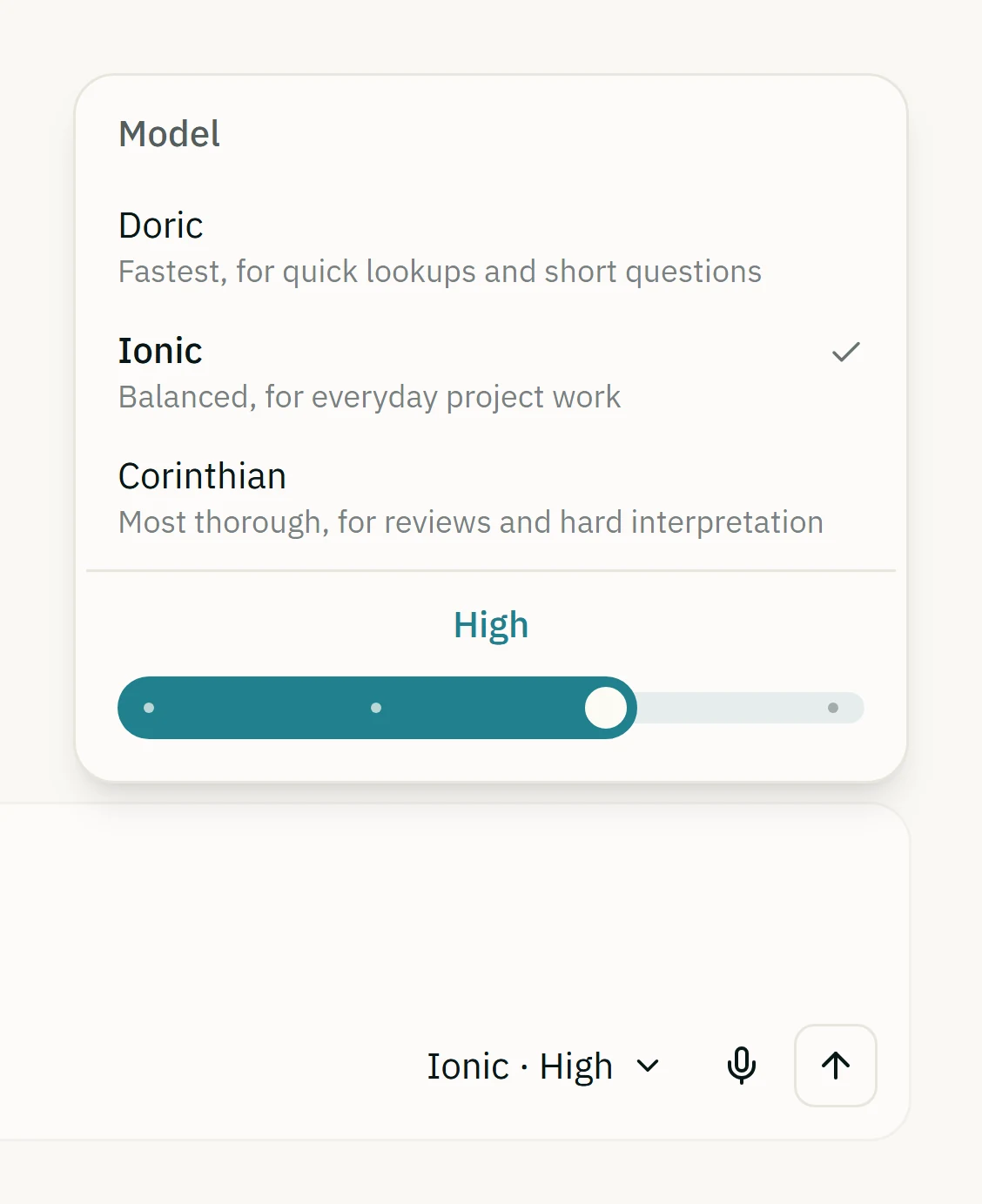
The button beside Send shows the tier and the reasoning, such as Ionic · High. Press it to choose. Your choice holds for that conversation, and each new chat starts on your plan's default again.
Doric
Fastest, for quick lookups and short questions.
A clause number, a definition, a figure from a table, or a quick check before you reply to an email.
Core answers on Doric. Plus and Max can choose it.
Ionic
Balanced, for everyday project work.
Questions about a project's drawings, site and documents, and most of the day-to-day work of a job.
Plus starts on Ionic. Max can choose it.
Corinthian
Most thorough, for reviews and hard interpretation.
Reviewing a drawing set, a question where several provisions bear on one another, a Performance Solution, or a close reading of a contract clause.
Max starts on Corinthian. Plus can choose it.
How long it reasons
Under the tiers, slide the reasoning from Low to Extra high. A chat in a project, or with a file attached, starts at High. Whatever you pick is what it runs at.
Low
Fastest, for quick lookups.
Medium
Balanced, for most questions.
High
Thinks longer on complex questions.
Extra high
Thinks longest and uses your limit fastest.
Where each plan starts
| Plan | Starts on | Can choose | Reasoning starts at |
|---|---|---|---|
| Core | Doric | Doric | High |
| Plus | Ionic | Doric, Ionic or Corinthian | High |
| Max | Corinthian | Doric, Ionic or Corinthian | Medium |
Every plan has a weekly usage limit, and every tier counts towards the same one. A more thorough tier, and more reasoning, use it faster, which is why Plus starts on Ionic: the week goes further, with Corinthian there when a question needs it. On the free plan, Ionic and Corinthian show a lock, and choosing one opens the plans.
Questions, answered
Which answer tier should I use?
Start on your plan's default and change it when the question asks for it: Doric for a quick lookup, Ionic for everyday project work, and Corinthian when you are reviewing a set or working through provisions that depend on one another.
Does the tier change what I pay?
No. Your plan's price stays the same whichever tier you choose. A more thorough tier, and more reasoning, use your weekly limit faster.
Can the free plan use Ionic or Corinthian?
No. The free Core plan answers on Doric. Plus and Max can choose any of the three tiers in every conversation.
Do the tiers search different sources?
No. Every tier searches the same library your plan includes and cites its sources the same way. A more thorough tier spends longer working through them.
Why are they called Doric, Ionic and Corinthian?
They are the three classical orders of architecture, from the plainest column to the most elaborate, which is how the tiers run from the fastest to the most thorough.
Ask it the question you were about to look up
Free for the NCC, state legislation, ABCB handbooks and practice notes, with citations, and planning information for any address in Australia. No credit card.