
The Infrastructure Beneath the Infrastructure.
By Matthew Secatore - Co-Founder of AEC Assistant 15 min read · Construction · Decision Intelligence · AEC Compliance · Infrastructure · AI
And the difference is about to reshape a $13 trillion industry...

By Matthew Secatore - Co-Founder of AEC Assistant
15 min read · Construction · Decision Intelligence · AEC Compliance · Infrastructure · AI
TL;DR: Construction is a $13 trillion industry running on 1990s information infrastructure. Productivity has grown just 0.4% annually for two decades. In Australia alone, regulatory non-compliance costs $2.5 billion a year. The problem isn’t a lack of software. It’s that every tool is built around search (finding a document) rather than intelligence (making a decision). Bloomberg did this for finance. Stripe did it for payments. Palantir did it for defence. Nobody has done it for construction. Built Environment Decision Intelligence (BEDI™) is the framework for building a cognitive layer that sits between fragmented codes and the professionals who need context-aware, decision-ready answers. Compliance is the entry point. The compounding query data is the moat. The window to establish infrastructure status is open now. We are registered architects, and we are building it. Next article: the Decision Intelligence Infrastructure (DII™) framework that maps how this gets built.
There is a building going up somewhere near you right now...
Maybe it's apartments. Maybe it's a hospital, a school, a data centre. It doesn't matter what. What matters is this: the people designing and constructing it will, at some point this week, spend hours hunting for information they already have access to. They will flip between PDFs. They will call a colleague, who will call another colleague. They will search a database, find a citation, and then spend another hour figuring out whether that citation actually applies to their specific building, in their specific location, under their specific set of constraints.
Then they will make a decision. And they will not be entirely sure it's the right one.
This is not a story about lazy people. The architects, engineers, builders and certifiers working on that building are among the most technically rigorous professionals in any room. This is a story about something more structural: the information infrastructure on which an entire industry has been forced to build its decisions on, and why that infrastructure was never fit for purpose.
The Paradox at the Heart of Construction
According to McKinsey & Company's 2024 analysis, based on data from IHS Markit and the McKinsey Global Institute, global construction output was $13 trillion in 2023 and is projected to reach $22 trillion by 2040.^1 It is the physical substrate of civilisation: every hospital, every road, every power grid, every home. Nothing exists in the built world that didn't first pass through a chain of decisions made by human beings working under pressure, against deadlines, with incomplete information.
And yet. As McKinsey's original 2017 report Reinventing Construction documented, labour productivity in construction has grown at just 1% annually over the past two decades, compared to 2.8% for the total world economy and 3.6% in manufacturing.^2 Their 2024 update revised the construction figure further downward to just 0.4% annually between 2000 and 2022.1 In the United States, research published in the Journal of Construction Engineering and Management found that construction productivity is lower today than it was in 1968.^3 Read that again. The industry that builds the world's physical infrastructure has become less productive over a period in which nearly every other sector has transformed itself through technology, process innovation, and data.
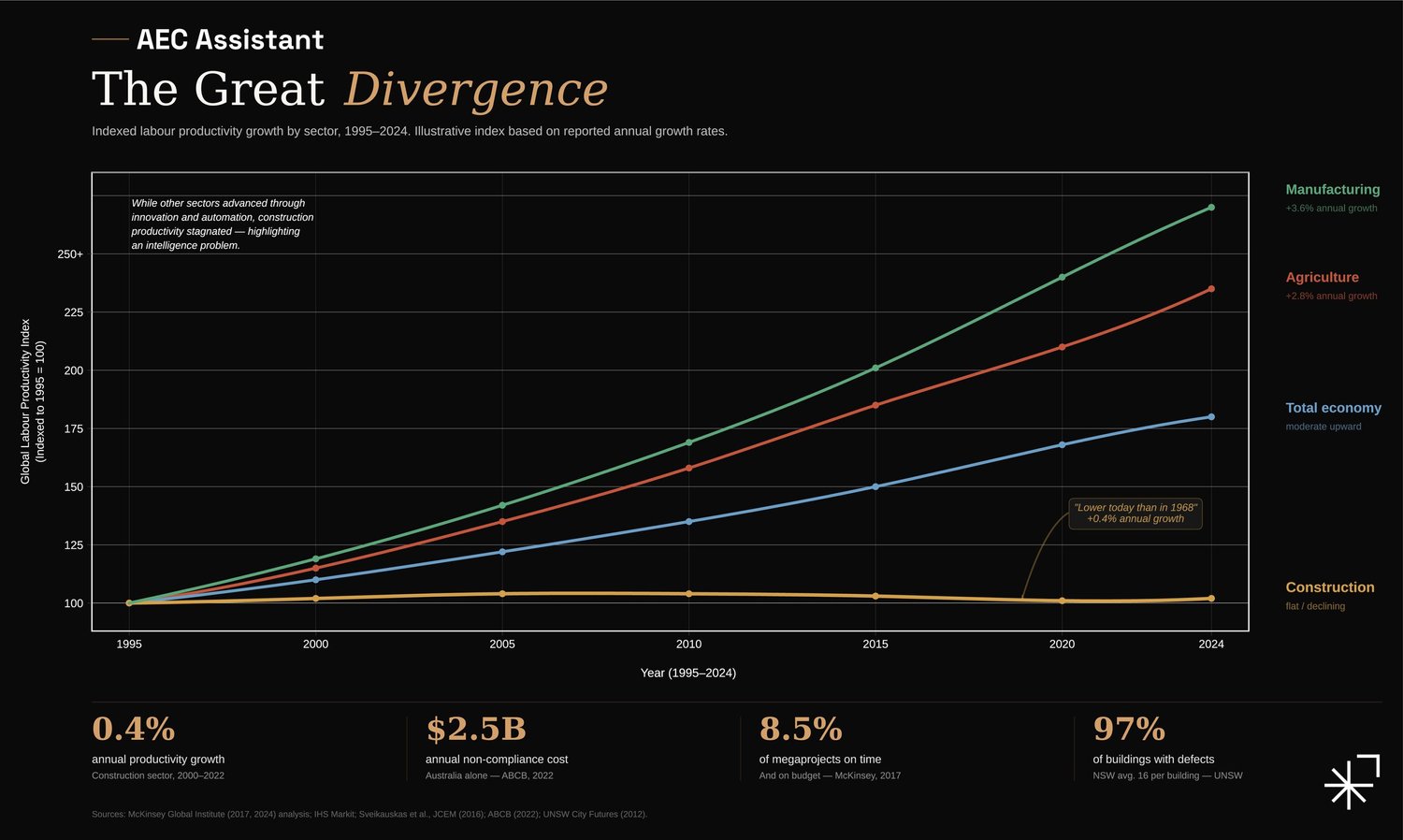
The consequences are staggering. According to the McKinsey Global Institute's analysis of project data, only 8.5% of mega projects are completed both on time and on budget, and approximately 30% of construction budgets are lost to inefficiency and rework.^2 Separate industry research cited in the same reports estimates that professionals spend an average of 5.5 hours per week, and some studies suggest more than 14 hours, simply searching for project information.^4 Not designing. Not building. Not solving problems... Searching.
The industry that shapes the physical world is operating on 1990s information infrastructure. The tools got faster. The intelligence stayed fragmented.
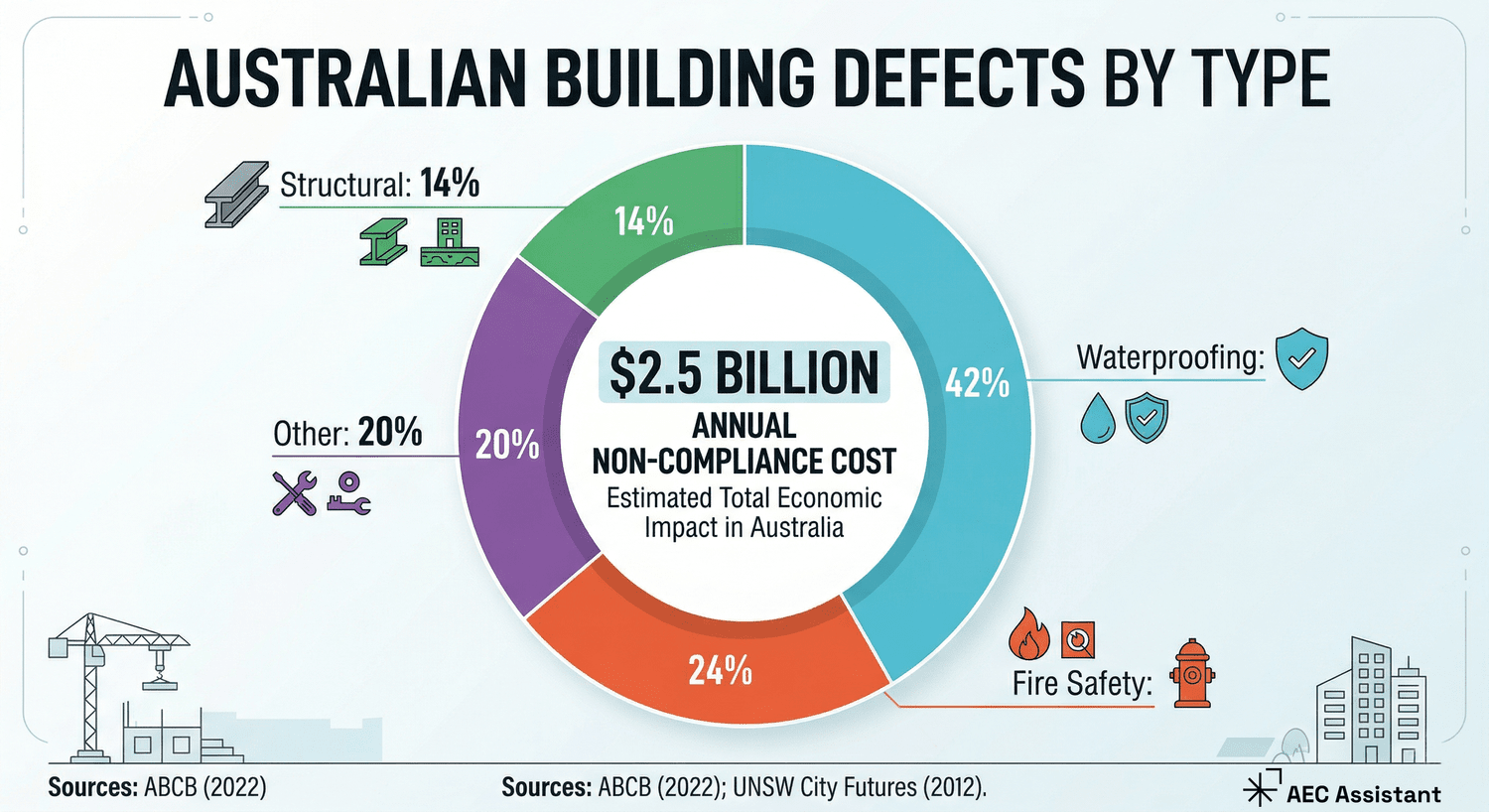
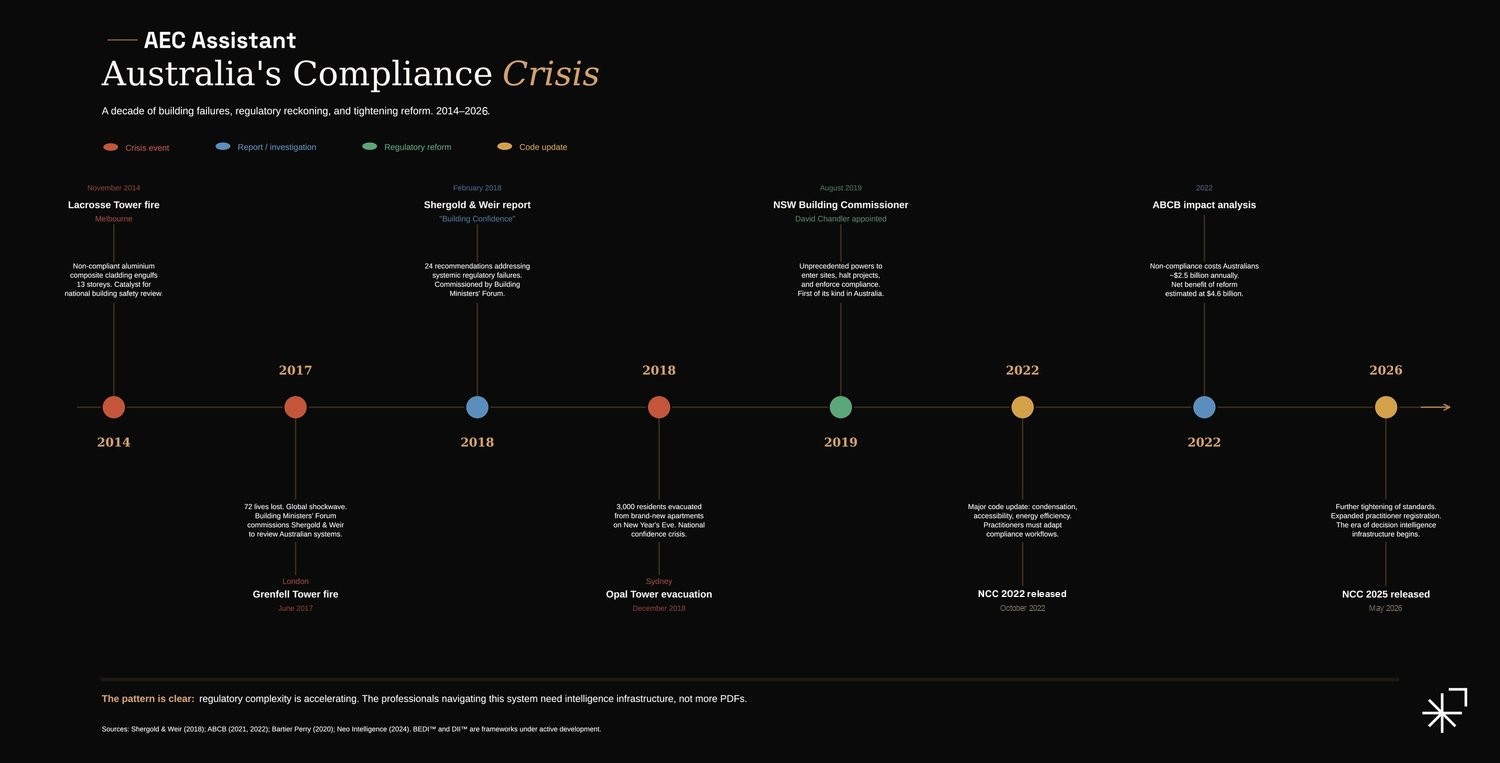
In Australia, where I work as a registered architect, the crisis has a sharper edge. In mid-2017, the Building Ministers' Forum commissioned Professor Peter Shergold and Bronwyn Weir to assess the effectiveness of compliance and enforcement systems for the building and construction industry across Australia. Their 2018 report, Building Confidence, found systemic regulatory non-compliance across the industry, concluding — as the Association of Consulting Architects summarised — that there was "insufficient supervision, auditing and expertise in the industry, and too many practitioners willing to take short cuts."56 A subsequent macro-economic impact analysis commissioned by the Australian Building Codes Board (ABCB) in 2022 estimated that building regulatory non-compliance costs Australians approximately $2.5 billion annually, with the most significant defects relating to waterproofing, weatherproofing, structural and fire safety.7 According to UNSW City Futures Research Centre data cited in the ABCB analysis, 97% of buildings surveyed in New South Wales had at least one defect, with an average of 16 defects per building.^7
These are failures rooted not in wilful negligence but in fragmented information, poor documentation, and a compliance system that demands perfection from professionals who are given broken tools.
Why More Technology Hasn't Fixed This
The construction industry is not short of software. It is drowning in it.
Autodesk, GRAPHISOFT, Bentley Systems, Trimble Construction, Nemetschek Group. These are just the authoring platforms — the tools architects and engineers use to draw, model, and document. Alongside them sits a sprawling ecosystem of SaaS products targeting every conceivable workflow: feasibility analysis, cost estimation, rendering, procurement, safety management, defect tracking, site diaries, and contract administration. According to a 2025 AECbytes analysis of the construction software market, there are now over 200 solutions available, making it one of the most fragmented software markets in any industry.^8 A 2025 Deloitte study of construction companies across Asia Pacific found that the typical firm uses a median of 11 separate data environments to manage its projects, with 48% of companies citing additional training costs and 45% citing higher operational costs as direct consequences of this fragmentation.^9
Each of these tools solves a real problem. But each solves it in isolation. The result is not a technology ecosystem. It is a patchwork of point solutions that do not communicate with each other, do not share context, and do not compound in value. Every tool is a silo. Every silo is a barrier to the kind of synthesis that good decisions actually require.
The industry has been here before. Building Information Modelling was supposed to be the answer. BIM promised a single, shared digital model of a building that every discipline could work from — a unified source of truth from design through construction to operation. The vision was, and remains, genuinely transformative. And there are projects where BIM has delivered on that promise spectacularly.
But for the vast majority of projects, BIM has not reached its potential. The reasons are structural, not technical. High implementation costs — including software licensing, hardware upgrades, and training — remain prohibitive for many firms, particularly small and medium practices that make up the bulk of the industry.^10 Research published in the Journal of Building Engineering in 2024 found that a lack of clarity on return on investment and the variability of reported savings across projects makes it difficult for stakeholders to justify the upfront expenditure.^10 Fee compression and compressed project timelines mean that the level of modelling required for BIM to deliver its full value is often the first thing sacrificed when budgets tighten. A 2024 academic review found that most organisations globally remain at BIM Level 2 maturity, falling short of the full integration that the technology was designed to enable.11 The promise remains valid. The delivery, on most projects, remains incomplete.
And then there are the platforms that sit at the centre of project delivery: the document management systems. Aconex (now part of Oracle Construction and Engineering) and Procore are the most prominent. These platforms have become near-ubiquitous on large projects, and for good reason — they bring structure and traceability to the chaotic flow of correspondence, drawings, RFIs, and transmittals that every project generates.
But at their core, they are repositories. Sophisticated, well-engineered repositories — but repositories nonetheless. They store documents. They track revisions. They manage permissions and audit trails. What they do not do is understand what those documents mean, how they relate to each other, or what a professional should do with the information contained within them. A document management system can tell you that a drawing was issued on a certain date, to certain recipients, at a certain revision. It cannot tell you whether the design shown on that drawing complies with the current code, whether the specified materials meet the relevant Australian Standards, or whether the structural engineer's assumptions align with the architect's documentation. It manages information. It does not synthesise it.
Both Procore and Oracle are actively investing in AI capabilities, and these are not companies to underestimate. Procore's platform now processes data from hundreds of thousands of projects globally. But the fundamental architecture of a document management system — built to store and organise files — is structurally different from an intelligence layer built to synthesise knowledge across sources and deliver context-aware decisions. Bolting intelligence onto a filing system is a different proposition from building intelligence as the foundation.
This is the landscape the industry operates in today. Powerful authoring tools that don't talk to each other. A transformative vision in BIM that most projects can't fully realise. Document management platforms that organise information brilliantly but don't help you understand what it means. And hundreds of point solutions, each solving one problem, none solving the underlying problem: that the professionals making the most consequential decisions in construction are still doing the synthesis themselves, manually, every time, from scratch.
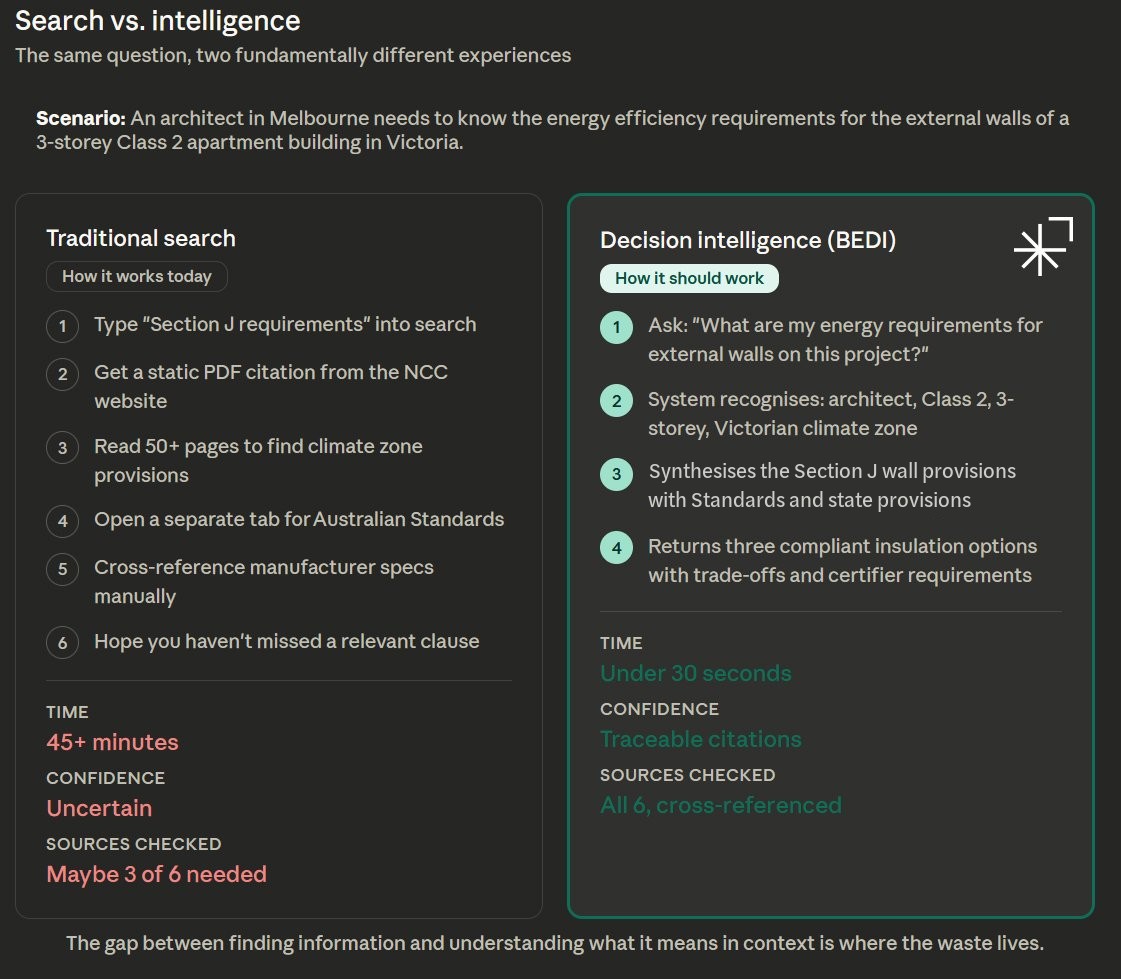
The distinction that matters is this. Search gives you a citation. Intelligence gives you a decision. Search tells you what the code says. Intelligence tells you how that code applies to your building, in your climate zone, for your building class, and what your certifier is going to ask for when they review it. That gap — between finding information and understanding what it means in context — is where virtually all of the waste, rework, and risk in construction actually lives.
What Infrastructure Looks Like When It Works
The best way to understand what the built environment is missing is to look at industries that have already made the leap from fragmented tools to unified intelligence infrastructure.
Bloomberg Terminal: From Fragmented Data to Decision Infrastructure
In 1981, Michael Bloomberg — having been fired from Salomon Brothers with $10 million in equity — founded Innovative Market Systems (later Bloomberg L.P.) based on his belief that Wall Street would pay a premium for high-quality business information delivered instantly on computer terminals. According to Bloomberg LP's own corporate history, Merrill Lynch became the first customer, purchasing a 30% stake for $30 million.^12^13
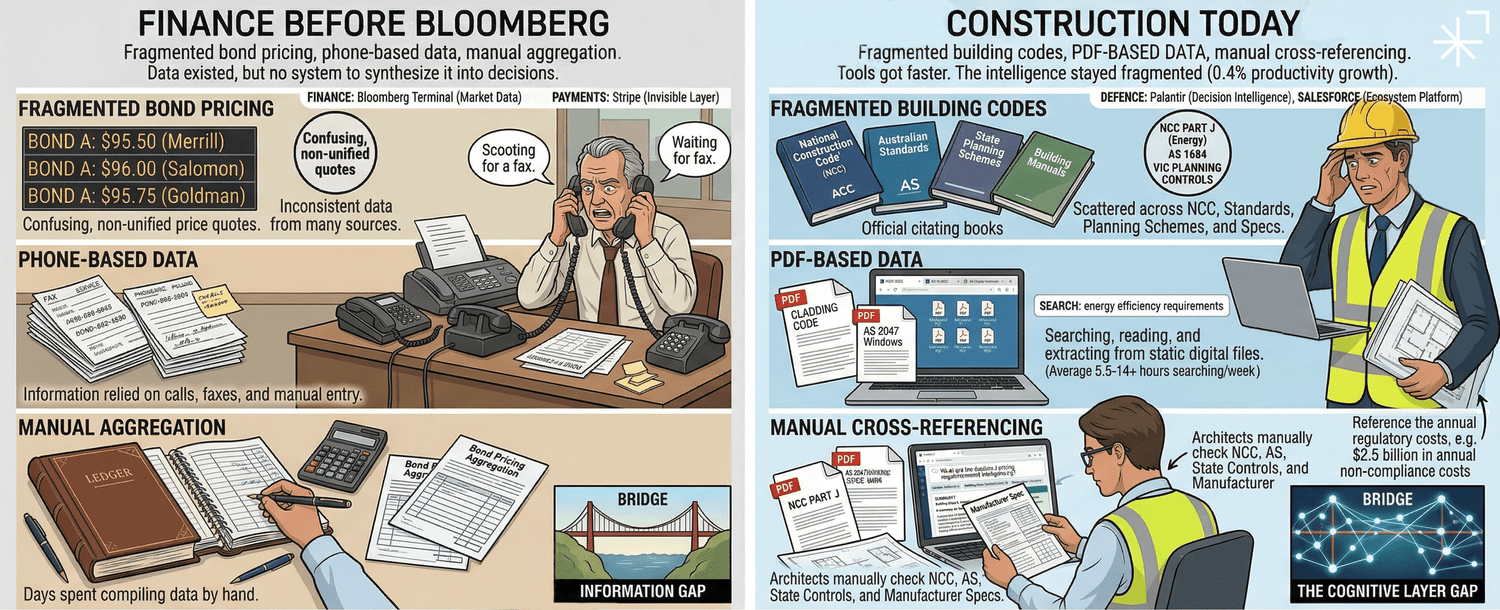
Bloomberg recognised that Wall Street had a data problem that looked remarkably similar to what construction faces today. Market data was scattered across inconsistent sources. Traders spent hours manually aggregating bond prices from phone calls and faxes. The information existed, but the infrastructure to synthesise it into decisions didn't.
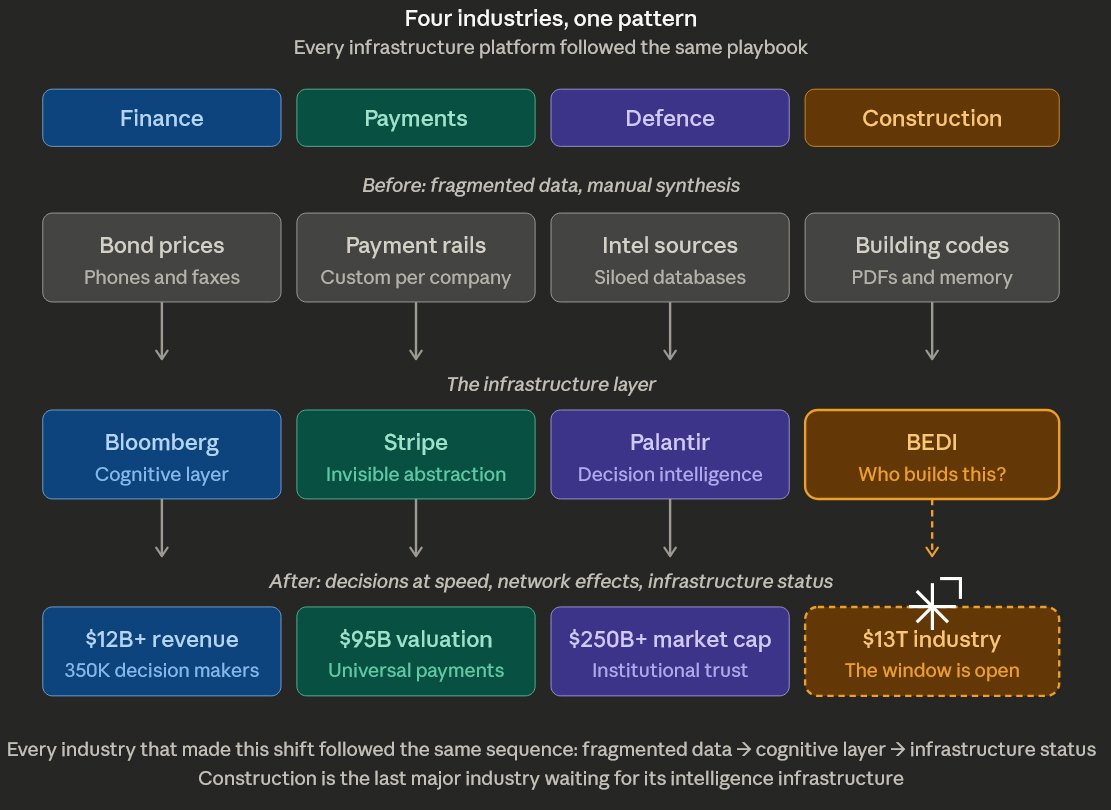
The Bloomberg Terminal didn't just digitise existing data. As Bloomberg LP describes it, the Terminal evolved from a standalone desktop device into "an entry point that gives users access to an ecosystem of financial data, analytics tools, and a communications network.^12 It created what I would call a cognitive layer: real-time analytics, contextual interpretation, and — critically — a network connecting over 350,000 financial decision-makers into a single ecosystem, according to Bloomberg Professional Services.^14 As reported by Yahoo Finance, the company now generates over $12 billion in annual revenue, largely from Terminal subscriptions.^15
The parallel to construction is my own observation, but the structural similarity is hard to miss. Replace "bond prices scattered across phone calls" with "building codes scattered across PDFs." Substitute "traders manually aggregating data" with "architects manually cross-referencing the NCC, Australian Standards, state planning schemes, and manufacturer specifications." The information exists. What's missing is the layer that synthesises it into context-aware, decision-ready intelligence.
Stripe: Making the Complex Invisible
Before Stripe, every company that needed to accept payments online had to build its own payment infrastructure. Negotiate with banks. Handle compliance. Manage fraud detection. The complexity was enormous, and most of it was identical from one company to the next.
Stripe didn't replace banks. It became the invisible layer between banks and every business that needed to transact. It abstracted away complexity so that developers could integrate payments in a few lines of code rather than months of custom engineering. Payments became infrastructure — invisible, reliable, and universal.
Construction's regulatory compliance layer is the same kind of problem. Every architect, every engineer, every builder, every certifier is independently navigating the same maze of codes, standards, and regulations. The work is duplicated millions of times across millions of projects. The complexity is enormous, and most of it is identical. What's missing is the layer that abstracts it away — not replacing the professional's judgement, but handling the routine synthesis so they can focus on the work that actually requires a trained human mind.
Palantir: Intelligence as Institutional Authority
Palantir Technologies built its reputation on a different kind of infrastructure: decision intelligence for institutions operating in high-stakes environments. Defence. Counter-terrorism. Pandemic response. The common thread isn't the domain — it's the problem. Organisations with vast quantities of fragmented data, operating under severe consequences for getting decisions wrong, need a synthesis layer they could actually trust.
Construction fits that profile precisely. The data is fragmented across dozens of sources. The consequences of wrong decisions are severe — according to the ABCB's 2022 analysis of cost data associated with the Shergold and Weir recommendations, a single compliance-related variation order in Australia averages approximately $20,000, and rework cycles can exceed $40,000.^7 Lives are at stake when fire safety or structural compliance is compromised. And yet the "intelligence layer" that professionals rely on for their most consequential decisions is still, functionally, a stack of PDFs and a good memory.
Bloomberg didn't replace traders. Stripe didn't replace banks. Palantir didn't replace analysts. They built the intelligence infrastructure that made those professionals more effective. Construction is waiting for the same shift.
This is the most important lesson for anyone watching the construction technology space. The companies that win in regulated, complex industries don't win by building the best tool. They win by becoming the layer that other tools depend on. The layer that, once embedded, is too valuable to remove. Not because it locks anyone in, but because it makes everyone who connects to it more effective.
Introducing Built Environment Decision Intelligence (BEDI™)
We call this shift Built Environment Decision Intelligence — or BEDI™. It is not a product category. It is an infrastructure category. And the distinction matters.
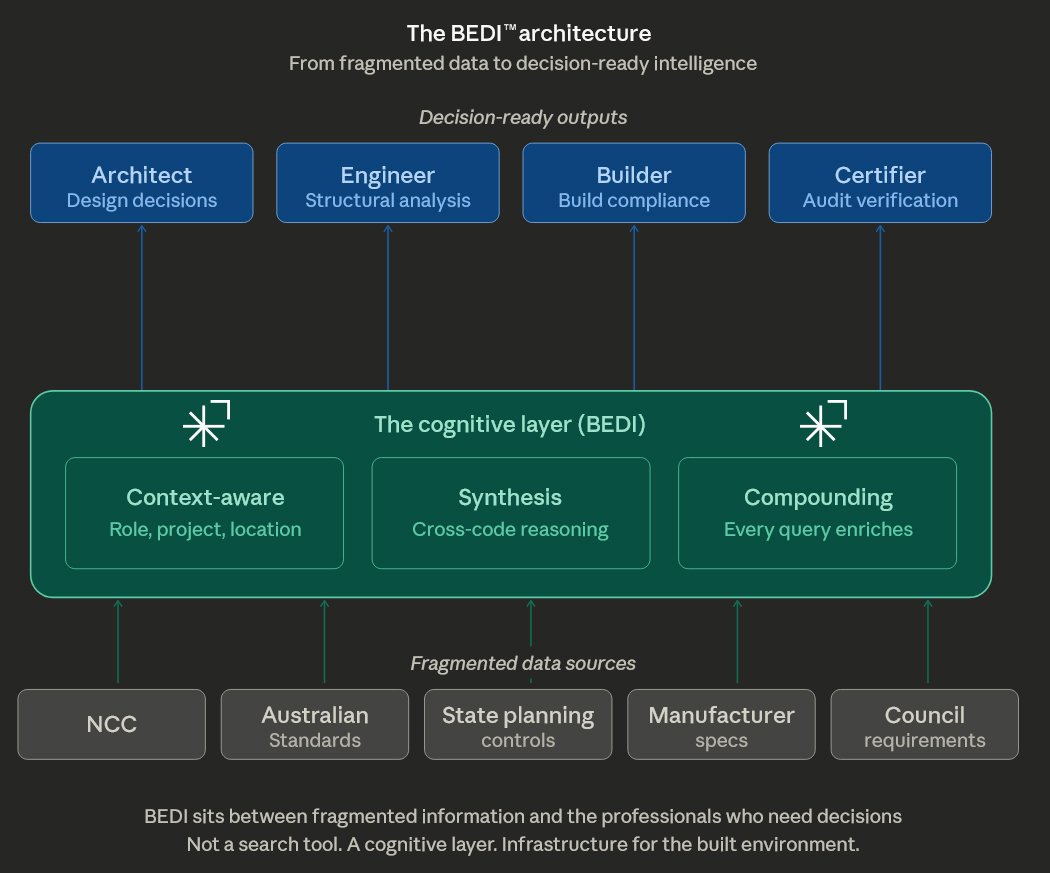
A product solves a task. You search for a code, you get a result. Infrastructure changes how an entire system operates. It sits between fragmented data sources and the professionals who need to make decisions, providing three things that no existing tool in the construction industry delivers simultaneously:
Context-awareness. Not a generic citation, but an answer that understands your role (architect, engineer, certifier), your project (Class 2 residential, 3 storeys, Victorian climate zone), and your specific constraints. The same question asked by a structural engineer and an architect should produce different answers, because they need different things.
Synthesis. Not a link to a PDF, but a unified insight that has already cross-referenced the National Construction Code, the relevant standards, the applicable state planning controls, and the manufacturer specifications. The professional's job should be to make the decision, not to assemble the inputs.
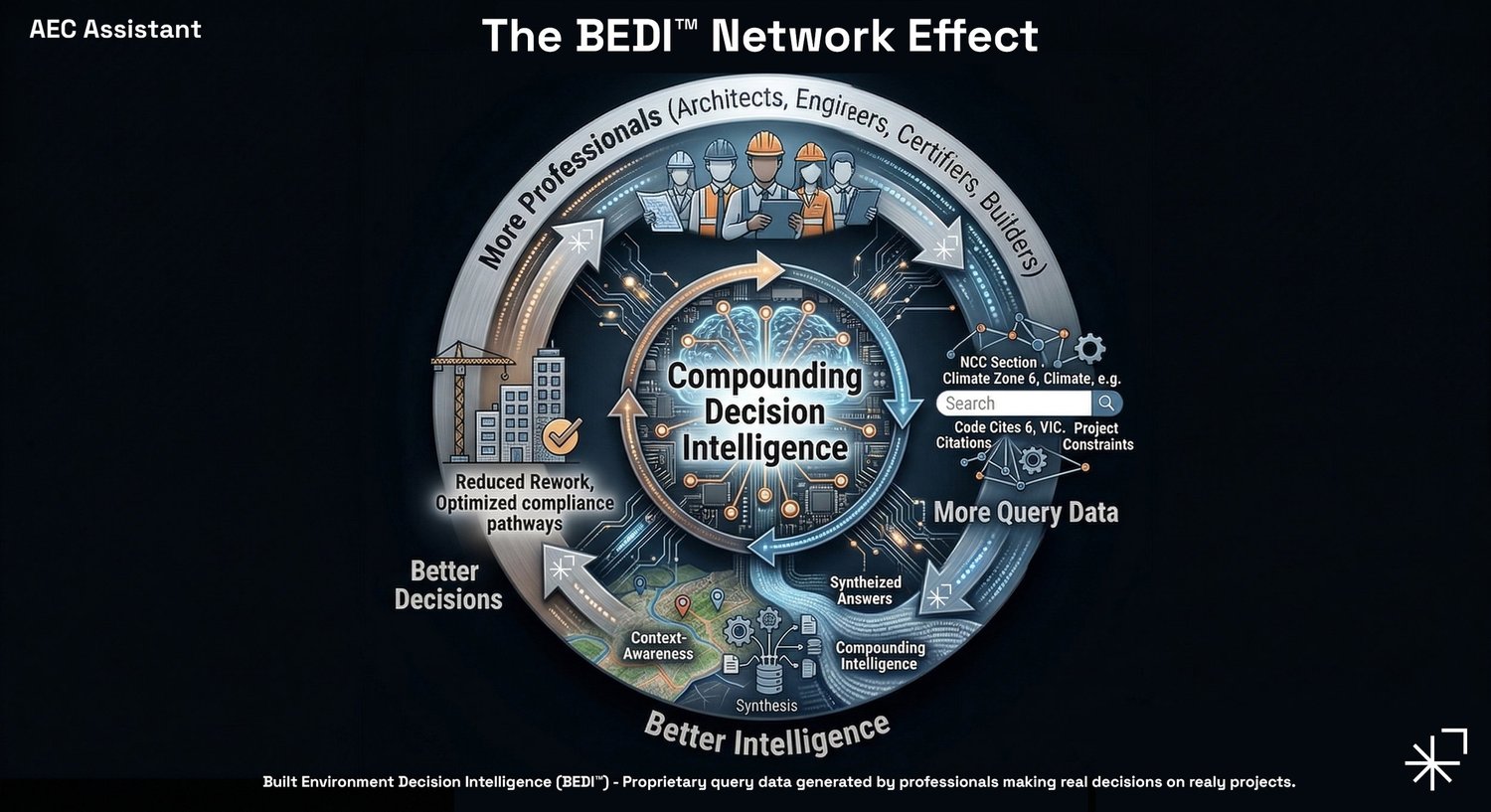
Compounding intelligence. Every query teaches the system. Every professional who connects enriches the intelligence available to everyone else. An architect in Melbourne asking about waterproofing compliance creates knowledge that helps a building surveyor in Brisbane assess the same issue next week. This is the network effect that separates infrastructure from tools — and it is the reason BEDI™ cannot be replicated by any single point solution, no matter how well-funded.
Why Compliance Is the Entry Point That Changes Everything
Every platform needs a wedge. Bloomberg started with bond pricing. Stripe started with online payments. Palantir started with scattered intelligence. The wedge isn't the destination — it's the entry point that proves the infrastructure works on the hardest, most measurable problem before expanding to everything else.
For the built environment, that wedge is regulatory compliance. Here's why...
Compliance is binary. A building is compliant, or it isn't. A decision is defensible, or it isn't. You can measure the quality of compliance intelligence in a way you cannot measure most other construction outcomes. That measurability is what makes it the ideal proving ground for decision intelligence.
Compliance is painful...
Senior professionals — people whose expertise lies in design, engineering, and problem-solving — are spending hours every week on what is, in effect, administrative research. Using the industry research figures cited by McKinsey (5.5 hours per week on information searching)^4 and typical senior professional billing rates ($150 to $300 per hour), this represents $600 to $1,200 per month in misallocated cognitive capacity per person.
Compliance is urgent...
Australia's regulatory landscape is actively tightening. The NCC 2025 introduced significant changes. State-based reforms stemming from the 24 recommendations in the Shergold and Weir report are being implemented across jurisdictions, as documented by the Australian Construction Industry Forum (ACIF) ongoing review of progress.^5^16 Practitioners' registration requirements are expanding. Documentation standards are being raised. The regulatory burden is increasing, and the tools available to manage it have not kept pace.
And compliance is consequential...
In NSW, as reported by Bartier Perry Lawyers in their 2020 analysis of the reforms, the appointment of David Chandler as Building Commissioner in August 2019 gave regulators unprecedented power to enter sites, inspect works, and halt projects under the new Residential Apartment Buildings (Compliance and Enforcement Powers) Act 2020.^17 Residents of Opal Tower (evacuated on New Year's Eve 2018) and Mascot Towers in Sydney became the human face of what happens when compliance fails. The Lacrosse Tower fire in Melbourne's Docklands (November 2014), which involved non-compliant aluminium composite cladding engulfing 13 storeys, became a national case study and one of the catalysts for the Shergold and Weir inquiry.^16^18 These aren't abstract risks. They are career-ending, life-threatening, and litigation-generating events that every professional in the industry carries in the back of their mind.
The Moat That Matters: Why Proprietary Query Data Changes the Game
In the age of generative AI, software is commoditised. Large language models are becoming cheaper and more capable by the month. Any well-funded team can build a chatbot that answers questions about building codes.
But a chatbot isn't infrastructure. And here is where BEDI™ diverges from the wave of "AI for construction" tools that have appeared over the past two years.
The real competitive moat is not the AI. It's the data. Specifically, it's the proprietary query data generated by real professionals making real decisions on real projects. Every time an architect asks about Section J requirements for a Class 2 building in Victoria, that query and its context become part of a growing intelligence graph. Over time, the system doesn't just know what the code says — it knows what professionals actually need from the code, which questions come up most often, which intersections between codes and standards create the most confusion, and which compliance pathways are most commonly chosen in practice.
This is the Bloomberg parallel again. As analysis by The Terminalist (2024) documents, Bloomberg's competitive moat was never just the data — it was the network effects created by 350,000+ professionals whose transactional activity generated proprietary intelligence that no competitor could replicate without the network itself.^19 The data and the network are the same thing.
In construction, the equivalent is a system where every professional's query enriches the intelligence available to every other professional. An engineer in Sydney and a certifier in Perth are, without realising it, contributing to a shared knowledge graph that improves the industry's decision-making. That compounding effect is the difference between a product and a platform — and it is the moat that no amount of venture capital can buy.
The Window Is Open. It Won't Stay Open.
There is a reason to write this now, and it isn't hype.
The technology to build BEDI™ — large language models capable of regulatory reasoning, vector databases for contextual retrieval, multimodal systems that can process drawings, specifications, and codes simultaneously — has only become viable in the last 18 months. Before that, the ambition outpaced the capability. Today, for the first time, the capability matches the ambition.
But the window for establishing infrastructure status is finite. The major platforms that already have distribution in construction — Procore Technologies, Autodesk Forma, and Oracle Construction and Engineering — are watching. Well-capitalised AI companies with no construction expertise are watching. The history of every infrastructure category shows the same pattern. There is a brief period in which a purpose-built solution, created by people who understand the domain at a structural level, can establish itself before the incumbents and the generalists catch up. Bloomberg had that window in finance. Stripe had it in payments. Once the window closes and infrastructure status is established, the switching costs make displacement nearly impossible.
Construction is in that window right now. The professionals who build the built world deserve an intelligence layer designed by people who have stood in their shoes — people who have navigated the NCC at 2 am before a deadline, fielded calls from certifiers questioning a compliance pathway, and lived the variation order that could have been prevented. That founder-market understanding is not something that can be acquired through market research or domain consultants. It has to be built in from the foundation.
That is exactly what we are doing. My co-founder, Andrew Galea, and I are both registered architects. Between us, we have worked on every side of the industry: as clients, consultants, and contractors. We have lived inside the compliance system this article describes. And we are building the infrastructure to replace it.
What Comes Next
Built Environment Decision Intelligence™ is not a prediction about what the future might hold. It is a description of the infrastructure the industry already needs — and a framework for building it deliberately rather than stumbling toward it.
Naming the category is the first step. But a category without architecture is just a label. Behind BEDI™ sits a structured framework we call Decision Intelligence Infrastructure (DII™) — a model that maps the maturity levels an organisation and an industry must progress through to move from fragmented search to genuine decision intelligence. From raw data ingestion through contextual synthesis to predictive, compounding intelligence that improves with every interaction across every stakeholder. We have been developing DII™ over the past three years, informed by the same cross-sector experience in architecture, engineering, and construction that made the problem visible in the first place. It is the operating blueprint for everything we are building. I will be unpacking the DII™ framework in detail in an upcoming article.
The professionals who design, engineer, certify, and construct the built world deserve better than the tools they have been given. Not marginally better. Fundamentally better. They deserve a layer of intelligence that understands their context. That synthesises on their behalf. That compounds in value the more it is used. That doesn't replace their expertise but amplifies it, freeing the cognitive capacity currently consumed by information hunting for the work that actually requires a trained human mind.
The buildings going up near you right now deserve to be built with better decisions than the ones currently being made. Not because the people making them aren't capable. Because the infrastructure supporting those decisions isn't worthy of the people relying on it.
We are building the cognitive layer for the built environment. We have named it. And we are already underway.
BEDI™ (Built Environment Decision Intelligence) and DII™ (Decision Intelligence Infrastructure) are frameworks in active development. Trademarks pending.
Disclosure:
The author is the co-founder of a company actively developing Built Environment Decision Intelligence infrastructure for the construction industry. The BEDI™ and DII™ frameworks and the analysis comparing construction's information infrastructure with Bloomberg, Stripe, Palantir, and Salesforce are the author's original strategic frameworks and observations. All statistical claims are attributed to their original sources in the Footnotes below. Where industry data has been used to calculate derived figures (such as the monthly cost of research time per professional), the calculation methodology and source inputs are stated in-text. No claim in this article relies on unattributed third-party research.
Footnotes:
McKinsey & Company (August 2024), "Delivering on Construction Productivity Is No Longer Optional." Based on data from IHS Markit and McKinsey Global Institute. Available at: mckinsey.com/capabilities/operations/our-insights/delivering-on-construction-productivity-is-no-longer-optional
McKinsey Global Institute (February 2017), "Reinventing Construction: A Route to Higher Productivity." Available at: mckinsey.com/capabilities/operations/our-insights/reinventing-construction-through-a-productivity-revolution
Sveikauskas, L. et al. (2016), "Productivity Growth in Construction," Journal of Construction Engineering and Management, Vol. 142, Issue 10, October 2016.
The 5.5 hours per week figure is cited across multiple McKinsey reports (2017, 2024) and industry analyses. Some Australian research, including analyses cited in the ABCB's work, suggests the figure may be higher (14+ hours). The range reflects variation in methodology and the definition of "information searching" across different studies.
Shergold, P. and Weir, B. (February 2018), "Building Confidence: Improving the Effectiveness of Compliance and Enforcement Systems for the Building and Construction Industry Across Australia." Commissioned by the Building Ministers' Forum. Available at: industry.gov.au
Association of Consulting Architects Australia (2020), "Building Confidence: The Shergold-Weir Report and its Implications for Architects." Available at: aca.org.au. The characterisation of "insufficient supervision, auditing and expertise" and practitioners "willing to take short cuts" is drawn from the ACA's analysis of the original Shergold & Weir findings (referencing p.13 of the original report).
Australian Building Codes Board (2022), "Building Confidence Report: A Case for Intervention" — Macro-economic Impact Analysis. The $2.5 billion annual cost figure, defect type breakdown, variation/rework cost estimates ($20,000 average variation order, $40,000+ rework cycles), and NSW defect prevalence data (97% of buildings, avg. 16 defects) are drawn from this analysis, which itself cites UNSW City Futures Research Centre (2012), "Governing the Compact City." Available at: abcb.gov.au
AECbytes (2025), "Software Consolidation in the AEC Workflow: The Case for Whole-Building Platforms." Analysis by Nathan Kegel, VP at IES. The "over 200 solutions" figure refers to the construction software market. Available at: aecbytes.com/viewpoint/2025/issue_123.html. The broader characterisation of construction software as "one of the most complex and fragmented markets" is also cited in Building Design+Construction's analysis of AEC project management tools.
Deloitte Australia / Deloitte Access Economics (February 2025), "State of Digital Adoption in the Construction Industry." The median of 11 data environments, 48% training cost concerns, and 45% operational cost concerns are from the Asia Pacific survey data. The report also found that businesses successfully integrating digital technologies could save approximately 10.5 hours per week by moving toward a more uniform data environment. Available at: deloitte.com/au/en/services/economics/analysis/state-digital-adoption-construction-industry.html
Quantifying the influence of BIM adoption: An in-depth methodology and practical case studies in construction (2024), Journal of Building Engineering, Volume 94, Article 109930. The research documented challenges including high initial investment requirements for software, training, and process restructuring, alongside a lack of clarity on return on investment and variability in reported savings across projects.
Comprehensive analysis of BIM adoption: From narrow focus to holistic understanding (2024), Automation in Construction. The scoping review of 146 papers found that most organisations remain at BIM Level 2 maturity, limiting potential for full integration. Available at: sciencedirect.com/science/article/pii/S0926580524000372
Bloomberg LP (November 2023), "Innovating a Modern Icon: How Bloomberg Keeps the Terminal Cutting-Edge." Available at: bloomberg.com/company/stories/innovating-a-modern-icon-how-bloomberg-keeps-the-terminal-cutting-edge
Wikipedia, "Bloomberg Terminal." The founding narrative (Salomon Brothers equity, Innovative Market Systems, Merrill Lynch's initial purchase) is well-documented public corporate history, corroborated across Bloomberg's own materials and multiple secondary sources.
Bloomberg Professional Services, "The Bloomberg Terminal: An Evolving Icon." The 350,000 user figure is stated by Bloomberg across multiple corporate communications. Available at: bloomberg.com/professional/products/bloomberg-terminal
The $12 billion+ annual revenue figure was reported by Yahoo Finance / Benzinga in March 2026, sourced from Bloomberg L.P.'s private financial disclosures. Bloomberg is not publicly traded and does not publish audited financials.
Neo Intelligence (May 2024), "Shergold and Weir Building Confidence Report Update: What Subcontractors Need to Know." Reports on the ACIF review of implementation progress and state-by-state reform status. Available at: neointelligence.com.au
Bartier Perry Lawyers (2020), "NSW Construction Industry Reforms Commence: Part 1." Analysis of David Chandler's appointment and the Residential Apartment Buildings (Compliance and Enforcement Powers) Act 2020 (NSW). Available at: bartier.com.au
Holding Redlich, "Shergold Weir Report, Non-Conforming Building Products and the Future of Certifiers." Background on the Lacrosse Tower fire and its role in prompting the Building Ministers' Forum inquiry. Available at: holdingredlich.com
The Terminalist (September 2024), "Bloomberg's 7 Powers & Why the Terminal Dominates Financial Markets." Analysis of Bloomberg's network effects and competitive moat. Available at: theterminalist.substack.com